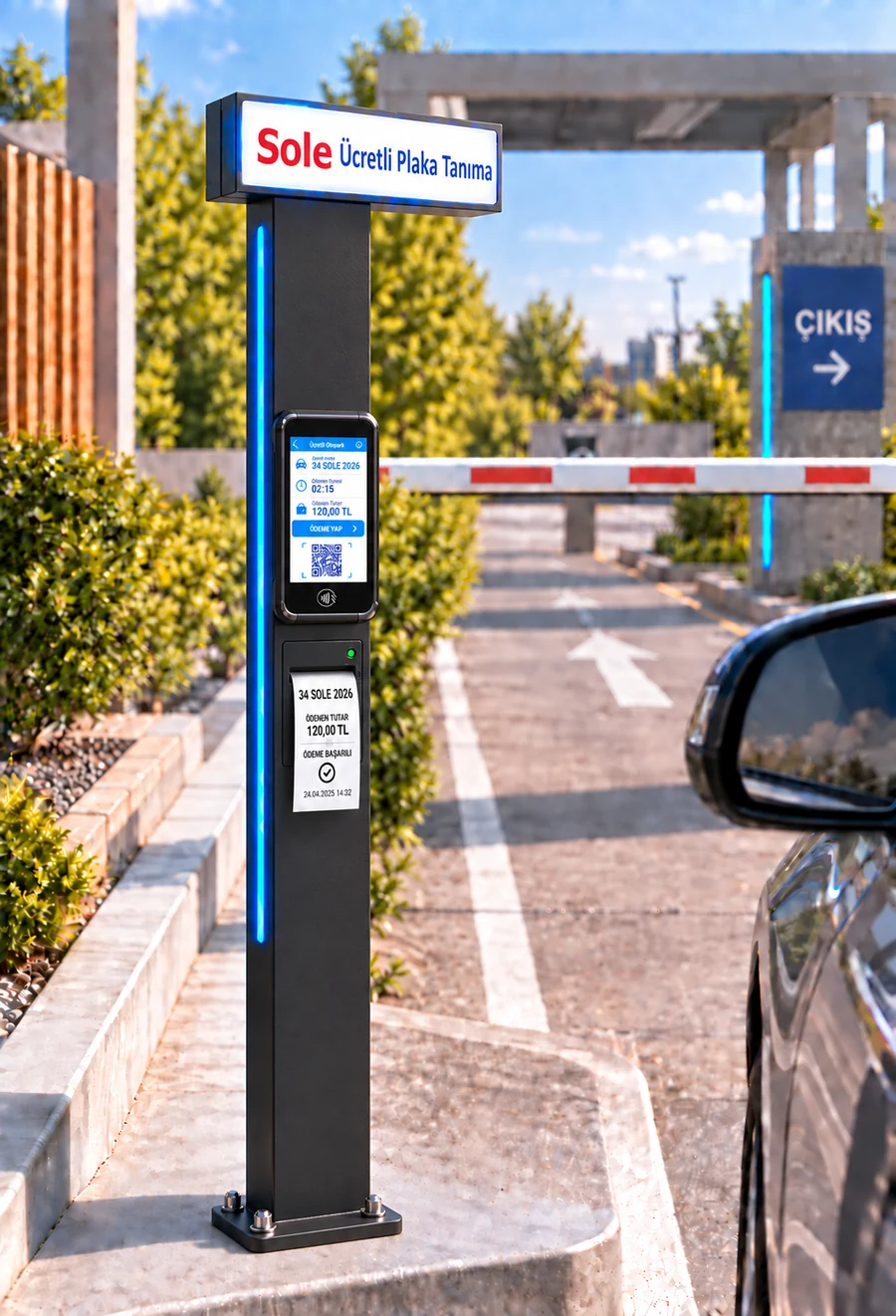
Direct answer: An existing car park is moved to the unmanned model by adding plate recognition cameras, a booth cabinet and a site PC to the entry and exit lanes, keeping suitable barriers, and installing a kiosk or exit terminal as the payment point. The switch usually does not happen in one step: at first the booth stays open at peak hours while kiosks and exit terminals take over in the evening and at night. Because subscribers are identified by plate, issuing tickets and cards stops.
Conversion steps
- Site survey: number of lanes, barrier condition, cable routes, pedestrian exits and daily vehicle count are reviewed.
- Existing barrier check: relay-controlled barriers are kept; opening time and mechanical condition are checked.
- Cameras and cabinet: a plate recognition camera for each entry and exit lane; PoE switch, electrical protection and relay connections in the booth cabinet.
- Choosing the payment point: a kiosk where there are pedestrian exits, an exit terminal for single-exit car parks, or both.
- Software setup: tariff, free period, vehicle classes, subscriber plates and user permissions are defined in the panel.
- Hybrid start: the booth stays open at peak hours; kiosks and exit terminals run in parallel and all channels are tracked in the same reports.
- Unmanned operation: as habits settle, booth hours are reduced; a handheld terminal or limited booth hours can remain for cash.
What is kept and what is added?
| Component | Usually |
|---|---|
| Boom barrier, sliding gate | Kept if relay-controlled |
| Booth | Used for the cabinet and site PC |
| Ticket machine | Retired |
| Subscriber cards | Replaced by plate definitions |
| Plate recognition camera | Added |
| Kiosk / exit terminal | Added |
| Site PC | Added |
How long does installation take?
It depends on the number of lanes and on cabling and trenching needs. In our reference plate recognition installations, a two-lane shopping mall car park went live in 2 days (Cassaba Mall) and a site with two control points in 3 days (Dragos Royal). The exact schedule including kiosks, tariffs and training is given after the survey.
Which car parks are good candidates?
Staffed car parks that already use plate recognition are the easiest to convert: in projects such as Günsa paid parking and Tekirdağ Bus Terminal, camera and barrier infrastructure is already in place, and kiosks and exit terminals can be added to move to the unmanned model. In ticketed car parks, cameras and cabinets come as additional work.
Frequently asked questions
Do I need to replace my existing barrier?
In most cases no. Relay-controlled barriers are kept.
Does the car park close during conversion?
Usually not. Installation can be done lane by lane; the booth keeps working during the conversion.
What happens to subscribers when moving from tickets?
Subscriber plates are defined in the panel; issuing cards and tickets stops.
Do I have to close the booth completely?
No. In the semi-unmanned model the booth can stay open at peak hours or for cash.
What does the conversion cost depend on?
The number of barriers kept, cameras and kiosks added, cabling and software scope. We quote after the survey.
Last updated: September 24, 2026 · Technical content: Gray Teknoloji project team
Get a free survey and quote →