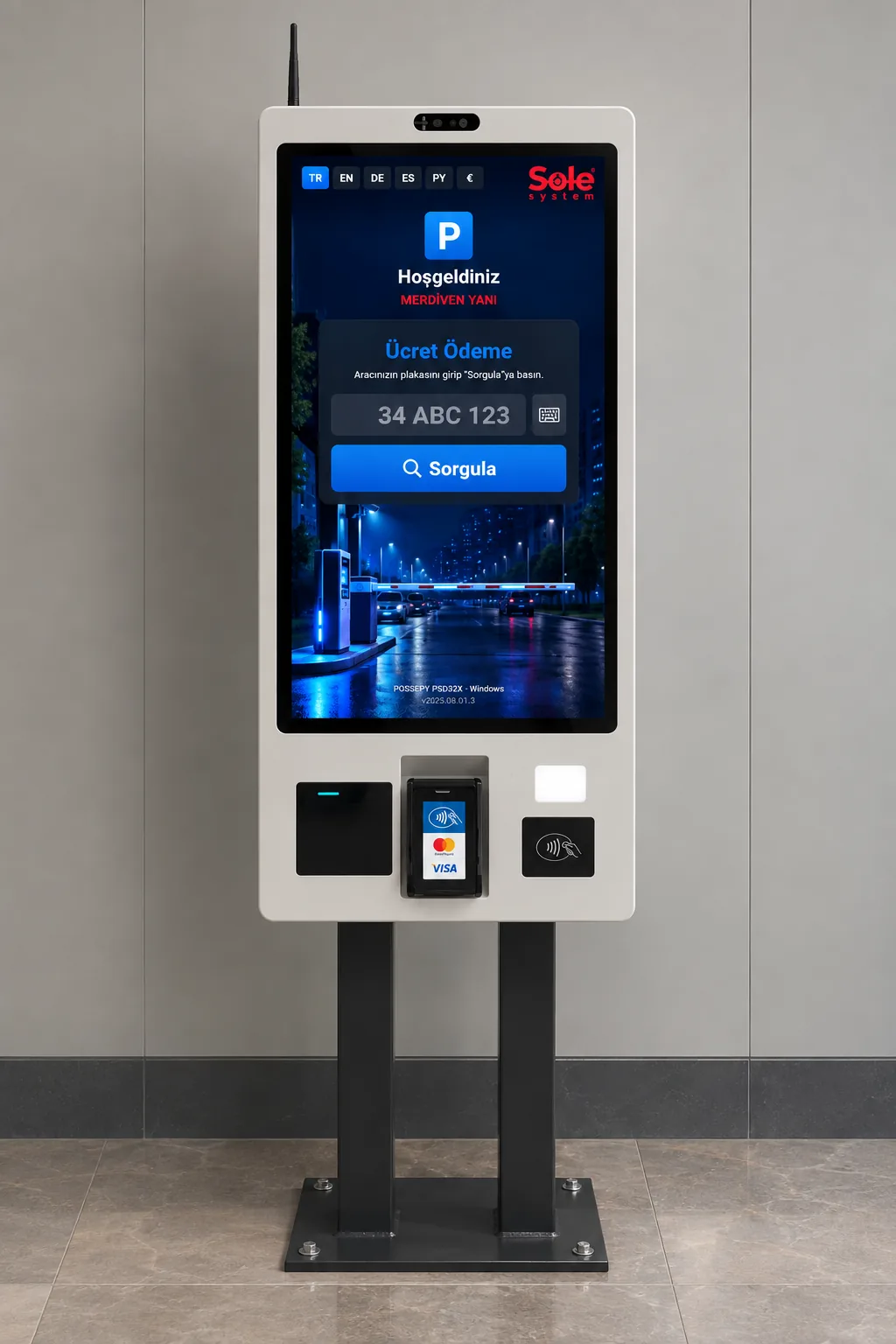
Direct answer: The price of a parking kiosk system depends on the number of kiosks and exit terminals, the number of lanes and cameras, whether barriers are new or existing, the booth cabinet and cabling, the software licence and installation conditions. That is why we give a project-based quote after a site survey instead of a fixed list price. Below are the items that make up the quote and the decisions that affect it.
Items that make up the price
| Item | Depends on | Note |
|---|---|---|
| Payment kiosk | Model (Smart, Small, Middle, Grand) and number | Number of pedestrian exits sets the count |
| Exit payment terminal | Number of exit lanes | Payment without leaving the car |
| Plate recognition camera | Number of entry and exit lanes | One camera per lane |
| Barrier | New or existing; arm length | Existing relay-controlled barriers are kept |
| Booth cabinet and cabling | Distance, trenching, PoE and switch needs | A wireless link can be considered |
| Site PC | Number of lanes and devices | For local decisions and offline operation |
| Software licence | Edition and modules used | The licence model is stated in the quote |
| Installation, training, maintenance | Site conditions and maintenance scope | Annual maintenance quoted separately |
Sample scenarios
One entry, one exit — small paid car park
2 plate recognition cameras, 2 barriers, 1 Smart KIOSK or 1 exit terminal, booth cabinet and site PC. Price: set according to project specifics.
Shopping mall or hospital — several pedestrian exits
A camera and barrier for each entry and exit lane, a kiosk at each main pedestrian point, exit terminals in the exit lanes; a booth or handheld terminal for peak hours. Price: set according to project specifics.
Converting a staffed car park to unmanned
Suitable existing barriers are kept; cameras, cabinet, site PC and kiosk are added; the booth can stay open at peak hours in a semi-unmanned model. Price: set according to project specifics.
Decisions that raise or lower the cost
| Raises | Lowers |
|---|---|
| Many pedestrian exits and kiosks | Keeping existing barriers |
| Long cable runs and trenching | Single entry-exit layout |
| Double-lane entries and exits | One exit terminal instead of a separate kiosk |
| Project-specific software integration | Standard reports being sufficient |
How is payback calculated?
It is never a single line item. On one side are cashier costs per shift, cash counting and an estimate of revenue leakage; on the other, kiosks, exit terminals, cameras, barriers, installation and annual maintenance. Payback period = total investment ÷ monthly saving, where the monthly saving is the reduced shift cost plus the additional revenue that gets recorded. During the survey we work these out with your facility's real vehicle count and average fee.
Annual running costs
- Receipt paper and consumables
- Bank transaction fees on card and QR payments
- Software licence (depending on the model)
- Routine maintenance and fault response
- Kiosk and camera cleaning
Frequently asked questions
How much does a parking kiosk cost?
The price depends on kiosk model and number, lanes and cameras, barrier status, cabinet and cabling, software licence and installation conditions. We give a project-based quote after a site survey.
What affects the cost of an unmanned car park most?
The number of pedestrian exits and lanes, and whether barriers are new or existing.
Does keeping my barrier lower the cost?
Yes. Existing barriers that can be controlled by a relay are kept, so no new barrier appears in the quote.
Is an exit terminal cheaper than a kiosk?
For car parks with a single exit, a payment terminal in the exit lane can be simpler than a separate pedestrian pay point. The choice depends on pedestrian flow.
What do you need for a quote?
The number of entry and exit lanes, daily vehicle count, existing barrier details and a layout plan. We gather these together during the free survey.
Last updated: September 24, 2026 · Features: Sole LPR and paid parking software
Get a free survey and quote →