
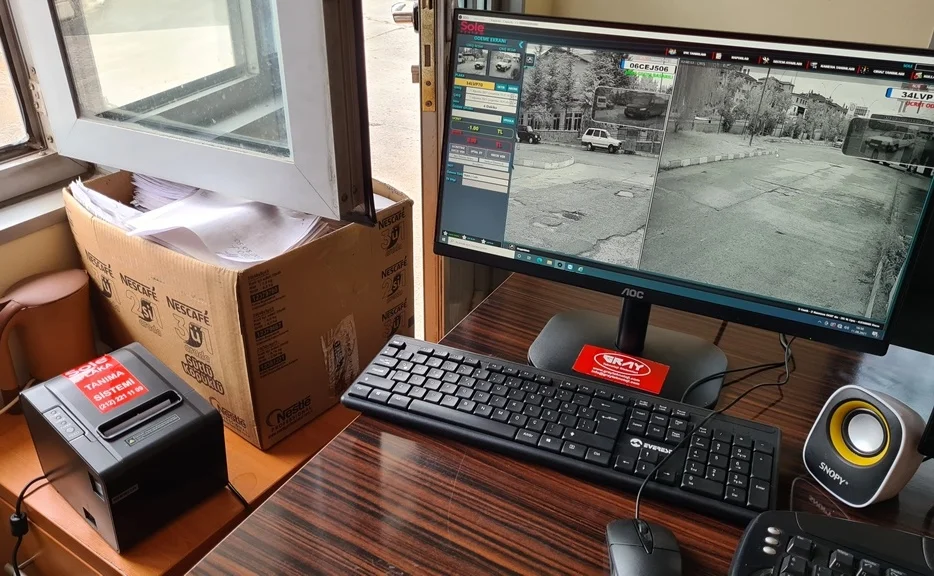
Direct answer: License plate recognition API integration is the software layer that securely shares the transit records and authorization lists produced by the on-site LPR system with ERP, parking, visitor, and central security software via REST API and webhooks. The physical system is collected in the guardhouse panel and runs on the local network; the API layer exposes this data to external software.
The REST API approach
The REST API exposes license plate records, authorization lists, and transit events in JSON format. Parking software, ERP, visitor management, or payment systems can call the vehicle-add, list-removal, and transit-query endpoints from their own interfaces.
Webhooks and event delivery
On every transit event (entry, exit, rejected vehicle), the system can send an instant notification to a defined webhook address. This means third-party software is notified the moment an event occurs, instead of polling periodically for data.
Authentication and logging
API access is protected with key-based (API key) or OAuth-based authentication. Which client accessed which endpoint and when is logged; these records are used for security audits and for diagnosing integration issues.
Which systems does it integrate with?
License plate data can be integrated with parking billing software, ERP and accounting systems, visitor/guest management applications, site management software, payment (POS/HGS toll) infrastructures, and central security/CCTV platforms. Integration can be set up at different layers, from device-level connections such as relay and TCP/IP to software-level endpoints such as REST API and webhooks.
Guardhouse panel and local network architecture
The physical system that feeds the API layer is collected in the panel at the entry/exit guardhouse. The panel houses PoE (which powers cameras over a single cable while carrying their data), a network switch, electrical protection components, and the relay card that opens the barrier. Cameras, the barrier relay card, and the LPR server connect to the same network through the same switch and communicate with each other via the TCP/IP protocol. Bringing all devices onto a single network ensures uninterrupted system operation; the API layer then securely exposes this local-network data to external software.
Quick technical facts
| API type | REST API (JSON) + webhook event delivery |
|---|---|
| Authentication | API key or OAuth |
| Guardhouse panel | PoE, switch, relay card, electrical protection |
| Communication | TCP/IP (all devices on the same switch/network) |
| Integration | Relay, TCP/IP, REST API, webhook |
| List management | Whitelist, blacklist, and guest |
| Reporting | Plate, date, time, direction, image |
| Operating model | Local, cloud, or hybrid |
Frequently asked questions
Which systems can license plate data be transferred to?
Parking billing, ERP, visitor management, site management, payment (POS/HGS toll), and central security software can access license plate transit data via REST API or webhook.
How do the devices communicate with each other?
Cameras, the barrier relay card, and the LPR server connect to the same network through the switch in the guardhouse panel and communicate via the TCP/IP protocol; the API layer exposes this local-network data externally.
How is API access secured?
API access is protected with an API key or OAuth, and every request is logged, so only authorized clients can access it and the access history can be audited.
Can this solution work without internet access?
When a local server or edge architecture is preferred, basic transit operations can continue without internet access.
How long does installation take?
The duration is determined after a site survey, based on field infrastructure and the number of lanes.
Does it integrate with an existing barrier?
Integration is possible with many barrier systems that support relay, TCP/IP, or API connectivity.
Last updated: July 21, 2026 · Technical content: Gray Teknoloji project team
Get a free survey and quote →