
Direct answer: A bollard is a cylindrical obstacle that rises and lowers from the ground via a hydraulic piston; it only lowers into the ground for an authorized vehicle's passage, otherwise remaining upright to physically block a vehicle from advancing. It offers a much higher level of physical security than an boom barrier.
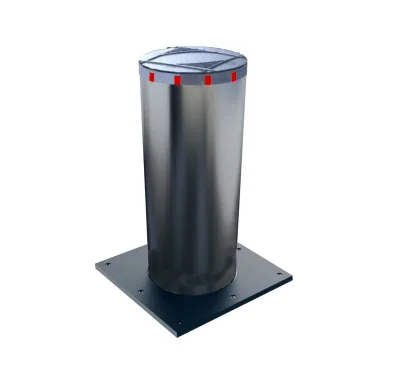
Hydraulic Single Bollard
Microprocessor-controlled, triggered by dry contact or a 3-50V DC pulse; can be manually lowered with a hand pump in an emergency. Our assessment: the single bollard is the model we use most often at single-lane private vehicle entrances, VIP parking spots, or controlled vehicle access into pedestrian zones.
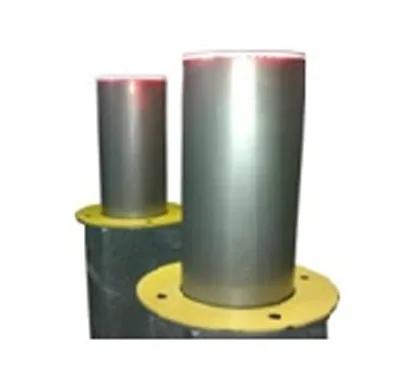
Hydraulic Dual Bollard
Our assessment: two synchronized bollards improve both security and transit comfort at medium-width entrances where a single bollard falls short (public buildings, bank branches, corporate campuses).
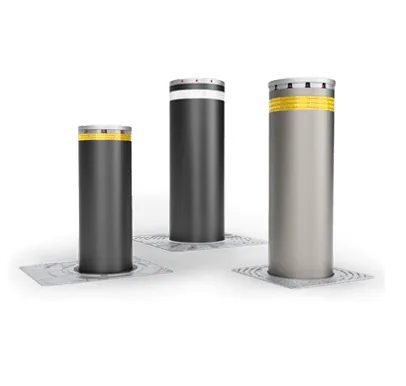
Hydraulic Triple Bollard
Our assessment: provides top-level physical blocking for three-lane or wide vehicle entrances; the most secure tier we'd recommend for critical infrastructure projects like airports, military facilities, or power plants.
Where are bollards used?
Bollards are preferred at points where an boom barrier's deterrence falls short and there is a risk of forced vehicle entry (government agencies, banks, VIP entrances, critical infrastructure). The recommendation for a single, dual, or triple set is finalized after the site survey based on the number of lanes and traffic density.
Safety components
A microprocessor-controlled control unit, triggering via dry contact or a 3-50V DC pulse, and a manual lowering feature via hand pump for emergencies are all standard. This means the bollard can still be manually lowered into the ground to allow passage even during a power outage.
Installation process
Because bollard installation requires embedding the hydraulic unit and cylinder in the ground, it requires more extensive ground preparation than an boom barrier. The site survey determines ground structure, number of lanes, and hydraulic line routing; installation is completed through excavation, cylinder mounting, hydraulic connections, and control-unit commissioning.
Maintenance and service
Checking hydraulic oil level and seal integrity, testing the cylinder motion sensors, and periodic checks of the control board and hand-pump mechanism are the standard steps of bollard maintenance; regular maintenance minimizes fault risk at points requiring high security.
Frequently asked questions
How long does bollard installation take?
Since the ground needs to be excavated and prepared for the hydraulic unit, bollard installation can take longer than an boom barrier; the timeline is confirmed after the site survey based on the number of lanes and site conditions.
What happens to a bollard during a power outage?
Bollards have a manual lowering feature via a hand pump for emergencies; during a power outage, the bollard can be manually lowered this way to allow passage.
Last updated: July 20, 2026 · Product images: Sole System product catalog
Get a free survey and quote →